
Heru's Journey of Spiritual Development
Since the dawn of human culture, hero's journeys have always been spiritual fiction tools used to illustrate and dramatize the general path of spiritual development and enlightenment. Here, in the script for Episode #3 of our Spiritual Fiction Podcast, we use the twelve stages of the hero's journey as a roadmap of spiritual development, and the myth of Lord Heru of Kemet as its symbolic representation.

The Hero's Prologue
The hero. Stories and tales and legends of the hero have been told ever since humanity gathered around the fire and fed their scraps to hungry and waiting wolves. Legends of heroes who overcame evil villains, terrifying devils and monstrous dragons. Tales of heroes who lived through chaos and brought peace to the world, and of heroes who braved strange and magical worlds to find riches unimaginable. Stories of valiant heroes in epic battles against the gods, and tales of modest heroes who simply did what had to be done, though life had never prepared them for the job.
These courageous acts have bewitched and mesmerized imaginations across every corner of the world for aeons and millenniums, and even today the world longs for ever greater, godlike super-heroes in movies and animations.
But why is the hero's journey so captivating to humans, and so integral to every culture? In this episode of the spiritual fiction podcast, we will show that since the dawn of human culture, hero's journeys have always been spiritual fiction tools used to illustrate and dramatize the general path of spiritual development and enlightenment. And we will show how the artistic and literary genre born in the age of Aquarius, the genre called Spiritual Fiction, is still using the art of storytelling in the service of spiritual cultivation.
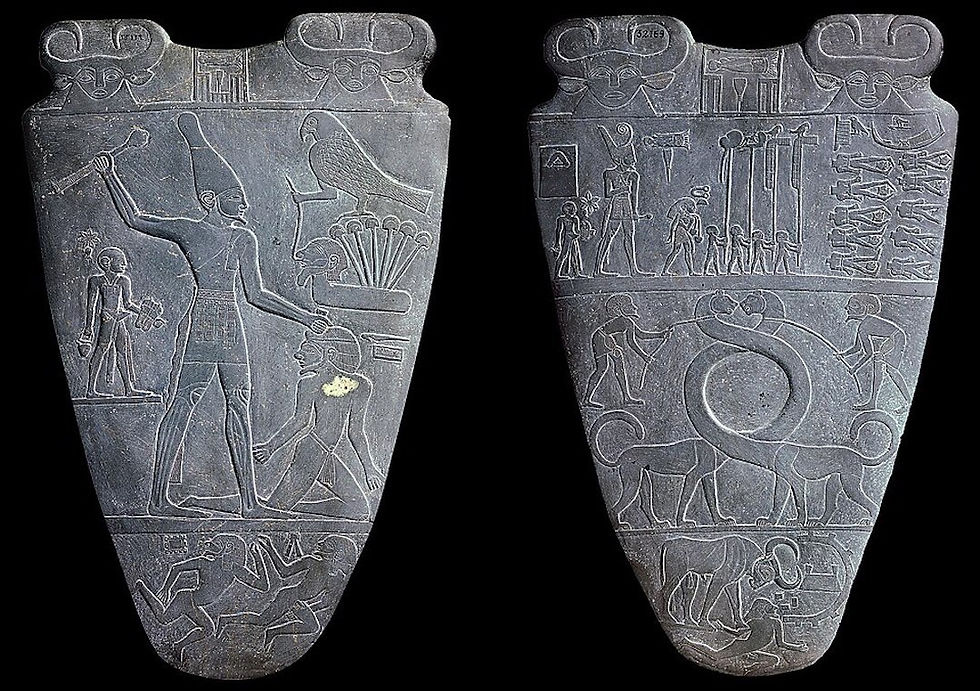
Welcome to the Spiritual Fiction Podcast! Here we discuss myths and ancient legends and spiritual beings from cultures all around the world, and we analyze the spiritual philosophies expressed through those epic and mythical symbols.
The myths of the many different human cultures are all filled with practical wisdom which can help us find joy during our daily challenges, and fulfillment during our lifelong hero's journeys. Too often we are unable to appreciate the wisdom of a spiritual system, either through an ignorance of that system, or through the incorrect assumption that it holds values opposed to our own.
Yet those who have compared these systems — such as the mythologist Joseph Campbell and the psychologist Carl Jung have regularly told us that they are saying basically the same thing, just in different languages, with different names and slightly different stories. Spirituality is a normal human expression of our need for deeper, transcendent meaning, and of our longing for a greater connection with the natural world and the human family.
The Hero's Journey and Spiritual Cultivation
In the last episode we showed how the hero's journey exemplifies any period of significant change in a person's life, and how it maps onto Carl Jung's process of individuation — each step reflecting a transformation in how we relate to our psyche, especially in integrating our shadow and in moving beyond a superficial ego into a persona that is more authentic and more heroic.
Yet we humans do not only have hidden psychological worlds inside us. According to every culture we also have a spirit and a soul within us, and it is from our understanding of the spirit and the soul that the field of psychology emerged. The word psyche originally meant spirit, or soul, or ghost to both Plato and Aristotle.
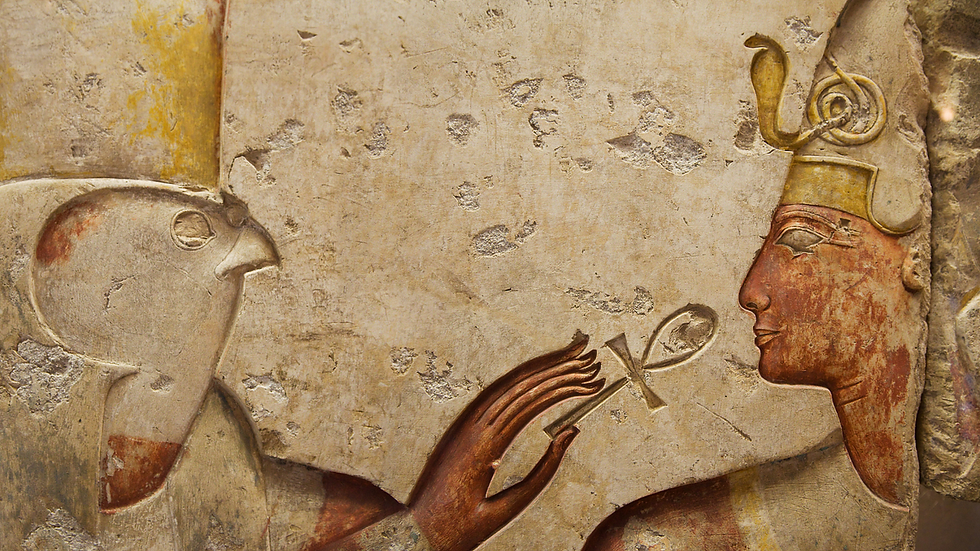
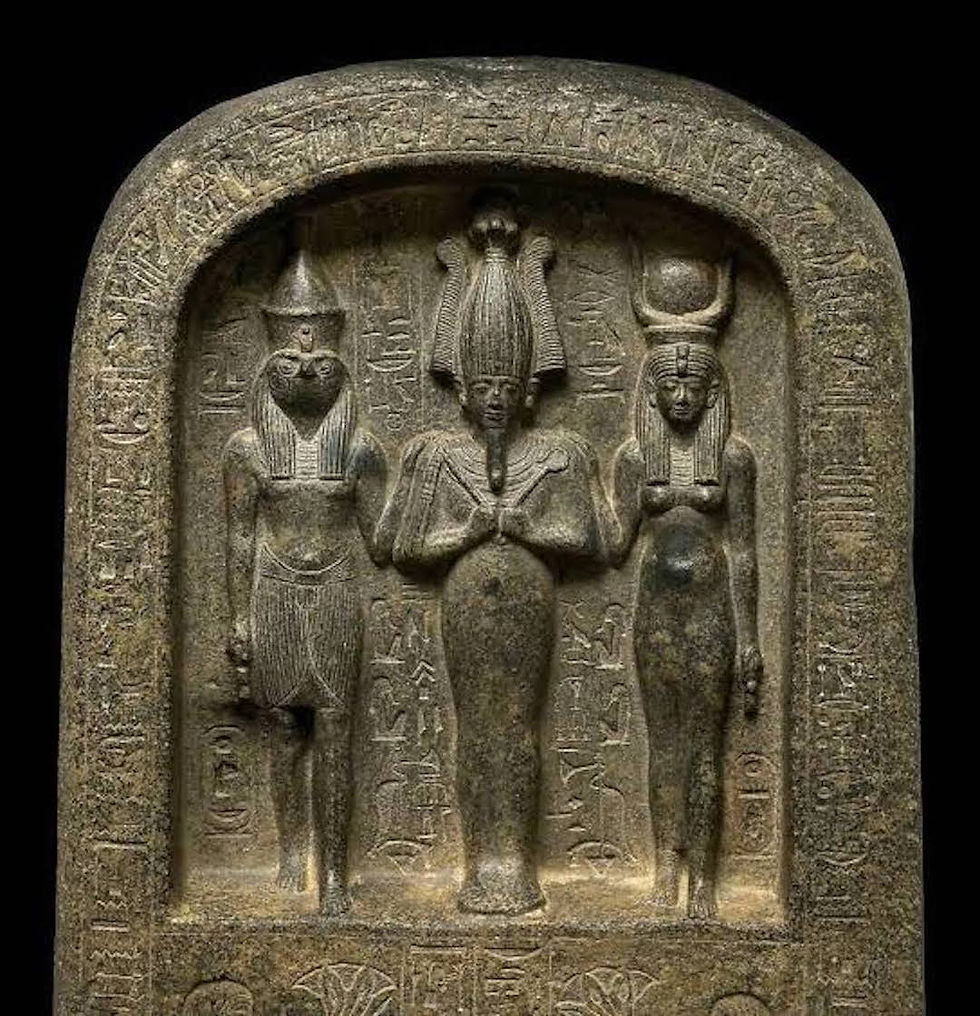
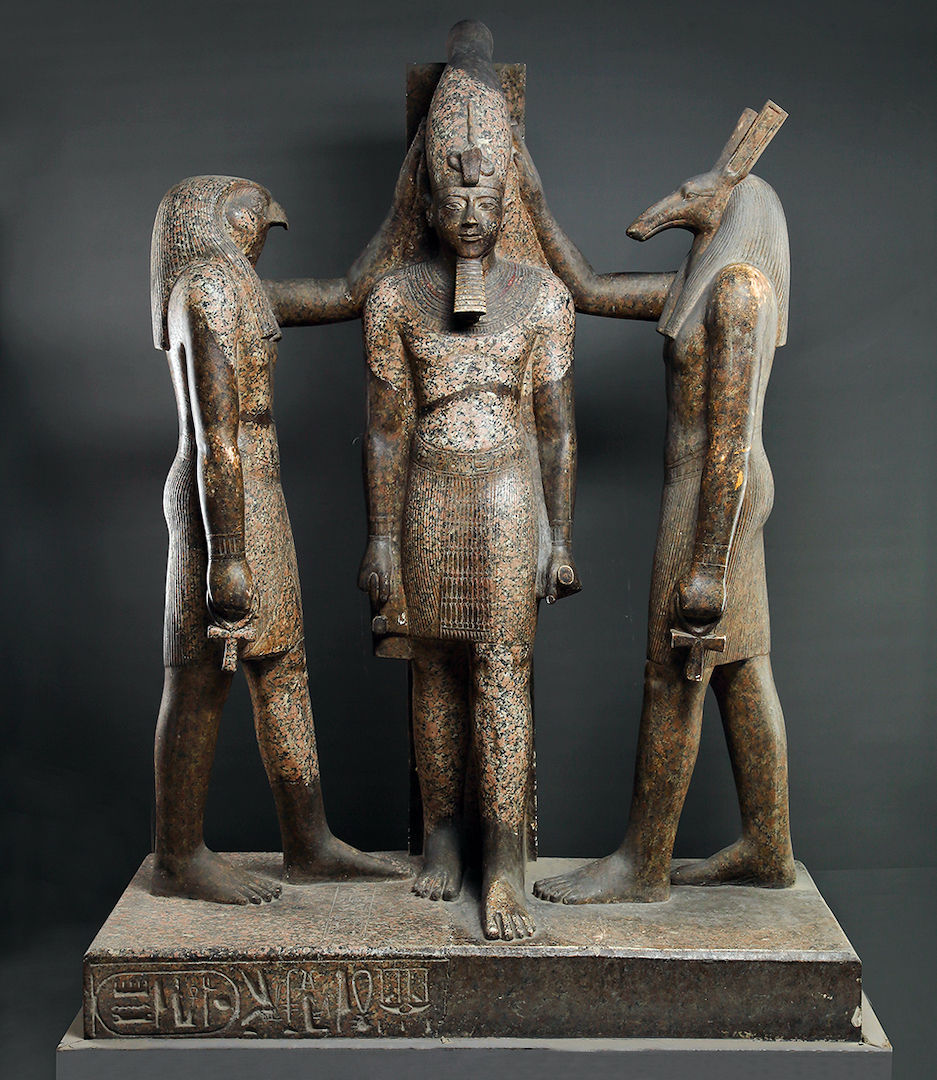
So before the hero's journey was a symbol of psychological change, it was first and foremost an aid to personal spiritual evolution. And the very first international hero on the planet was a spiritual hero: the falcon-headed deity, the protector of kings and pharaohs, god of the sky, Lord Heru, also known as Horus of Kemet. It was the story of Heru that gave the world the concept and the word hero, over seven milleniums ago. His journey — from immaculate conception all the way to atonement, spiritual redemption, and everlasting life after death — is the journey of our own soul, and many of the feats attributed to Jesus, Muhammed, Buddha, and Krishna were first performed by Lord Heru.
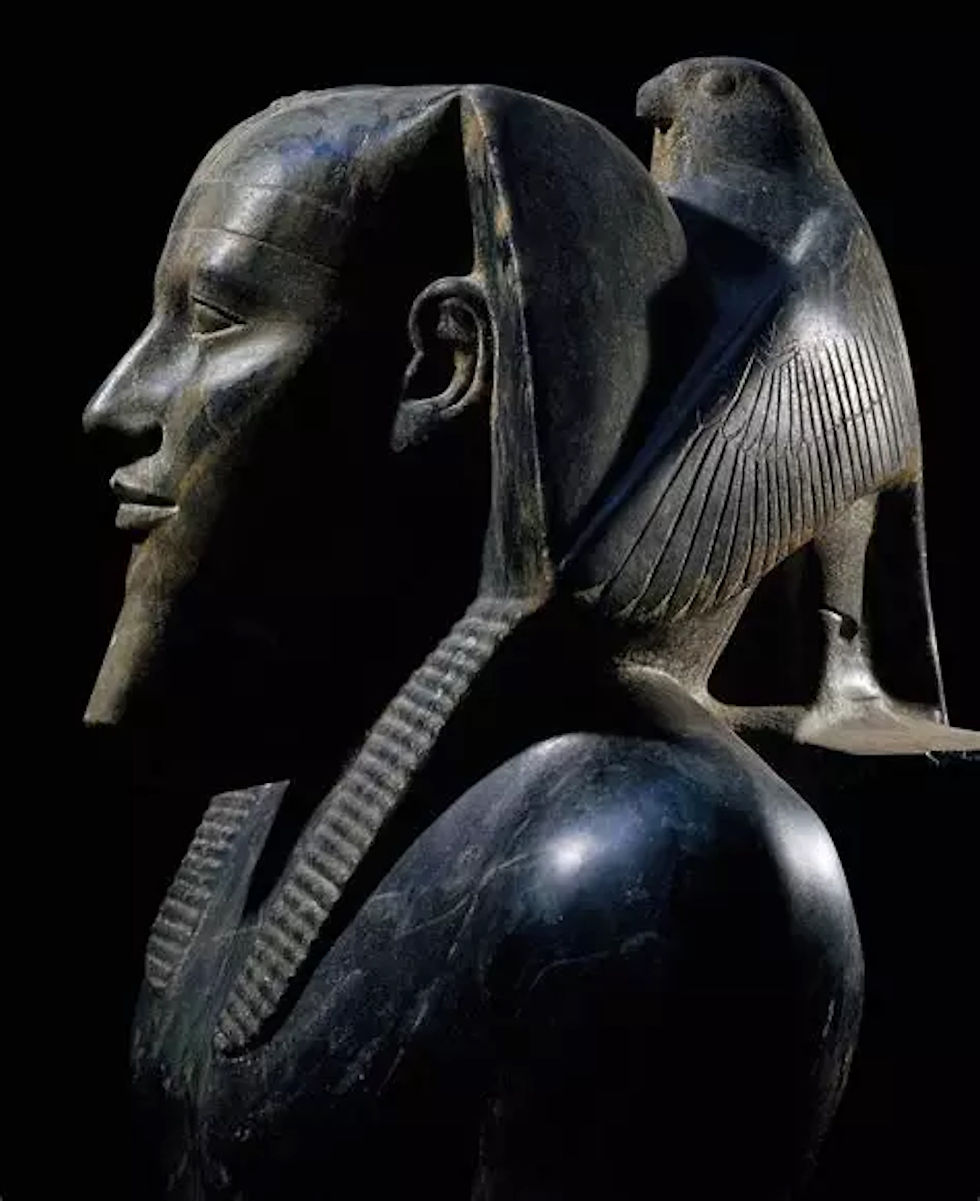
So what is the real story of Heru? Few publicly held artifacts detail it from start to finish, yet many sources can be assembled into what might be called the general Kemetic story of Heru. That story was adapted and revised throughout the millenniums of Kemet's history, changed slightly for every ritual occasion, so the story of Heru is an ever-living story, and it can be considered living spirituality.
The version I now recount excludes the details added in much later by Plutarch, who was Greek: there is no perfectly measured coffin, nothing about a body part eaten by fish, and nothing about Heru's fury against his own mother. Every source behind this reconstruction is listed at the end.
Heru's Everliving Story
I. The Lost Golden Age
Ausar and Auset ruled Kemet according to Maat, and under them the land was in harmonious balance. The stars and the river rose and fell on schedule, grain and milk and honey were given to the needy, and the people lived according to Ubuntu and equality.
When the work of Kemet was complete, they went out to carry it to the rest of the world — to teach agriculture, astronomy, political science, alchemy, and ancestor veneration. Asar left the throne of Kemet in the hands of his loyal and fierce brother, Set.
Upon their return to Kemet, Set met the couple in the papyrus channels of the Delta with Maga — his commander and eldest son — along with a company of his elite warriors. They ambushed Asar not in their human forms but in their war-forms: Set had become a monstrous hippopotamus, and Maga was in his Titan-Crocodile form. They took Asar in the shallow water, where Set dismembered him into fourteen pieces.

II. Dividing the Light
Set had Maga and his warriors scatter the pieces across Kemet, so that Asar's dead soul would not be wedjat in Duat - meaning whole the underworld. A soul that is not whole and sound cannot be admitted into the Court of Righteousness, which is the court in the underworld where Lord Atum presides.
Such a soul can thus not receive its final judgement, nor its rewards, nor the powers it should inherit in Duat. A soul that cannot be heard in court also cannot file a complaint or testify against other souls. By scattering his light-body, Set had made Asar ineligible to accuse him of the capital offense of fratricide.
III. The Re-unification
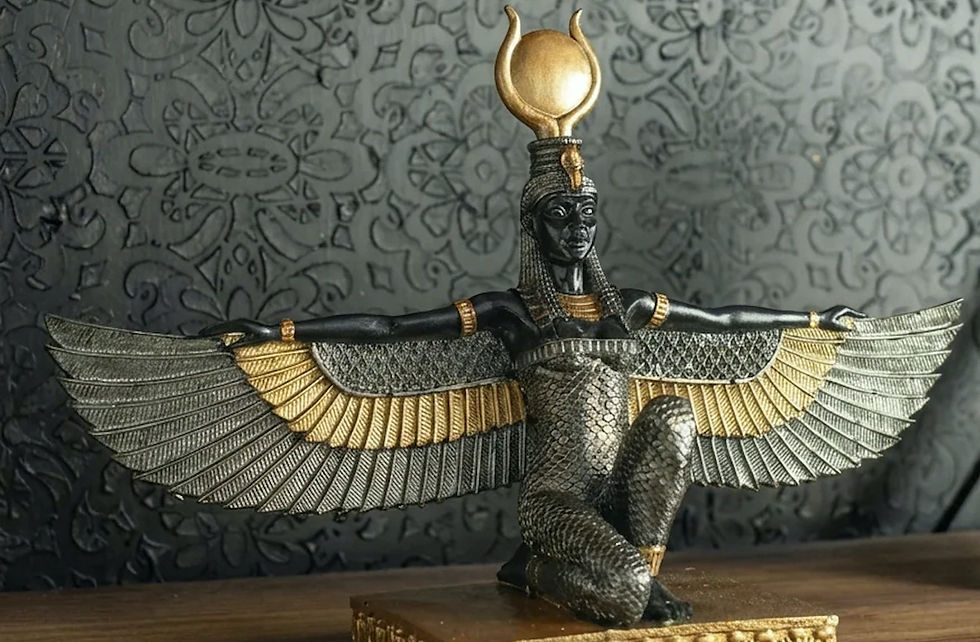
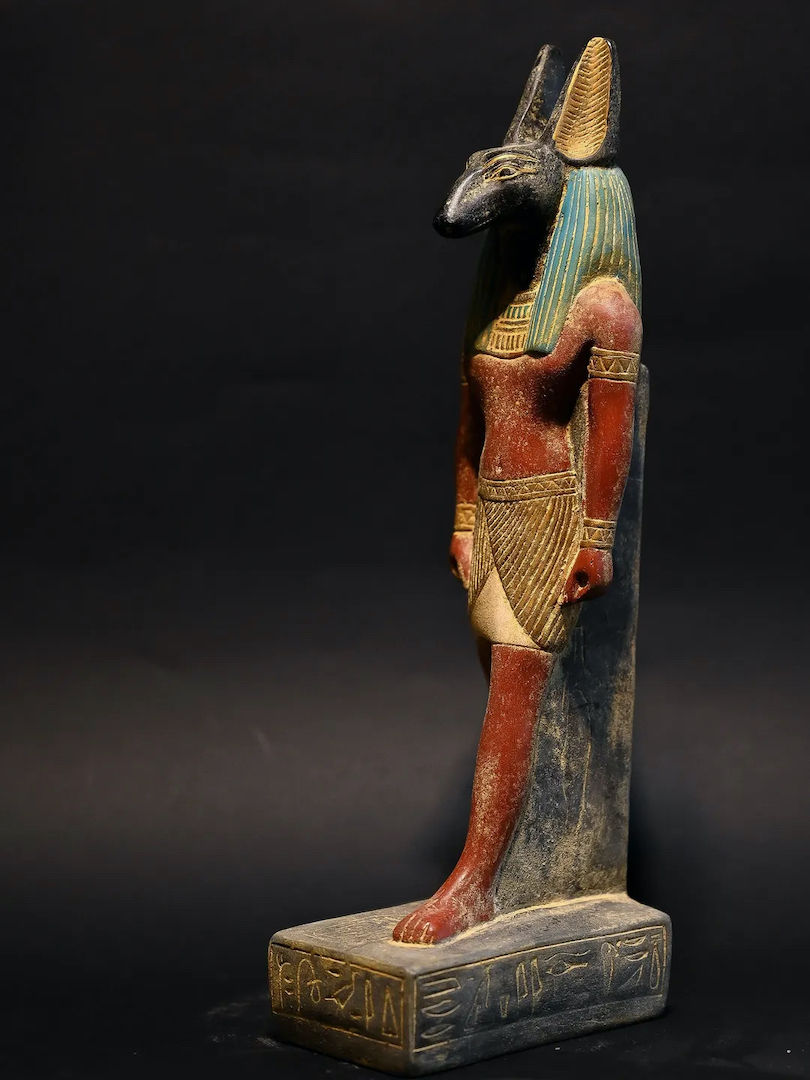
Aset did as Asar asked, and escaped during the ambush. She took on her form as a divine kite — the hunting bird that quarters the ground in long patient sweeps. Aset went to Anpu, commander of Asar's armed forces, and together they crossed Kemet from the cataracts to the sea. Along with other divine aides, they were finally able to recover all fourteen pieces of Asar's light-body.
IV. The Light-Code Lightning
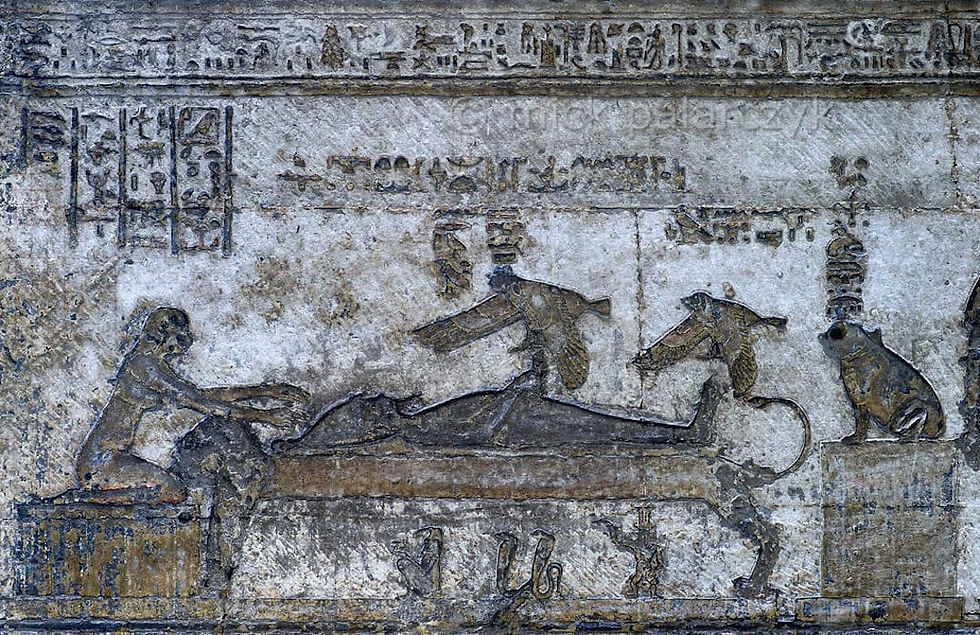
With assistance from Anpu and Nebet-Het, Aset assembled the pieces and bound them in linen, creating the archetype of the mummy.
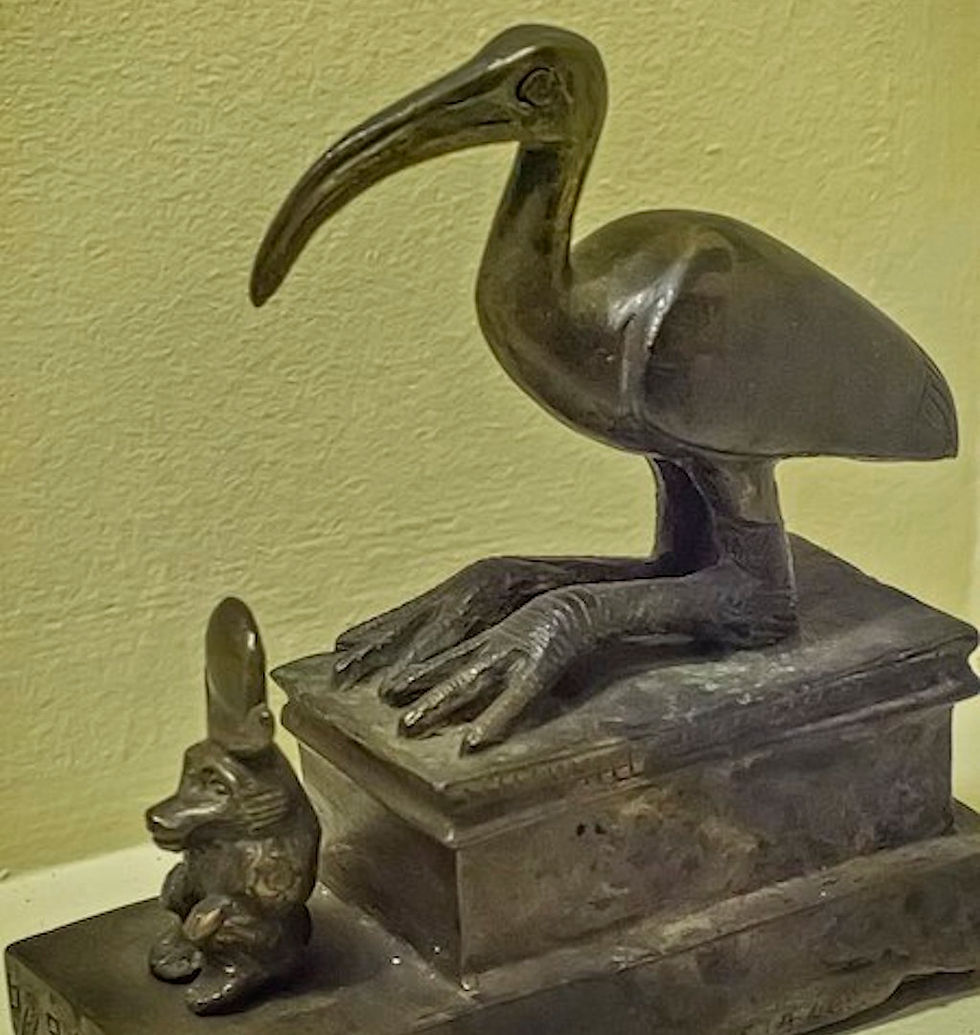
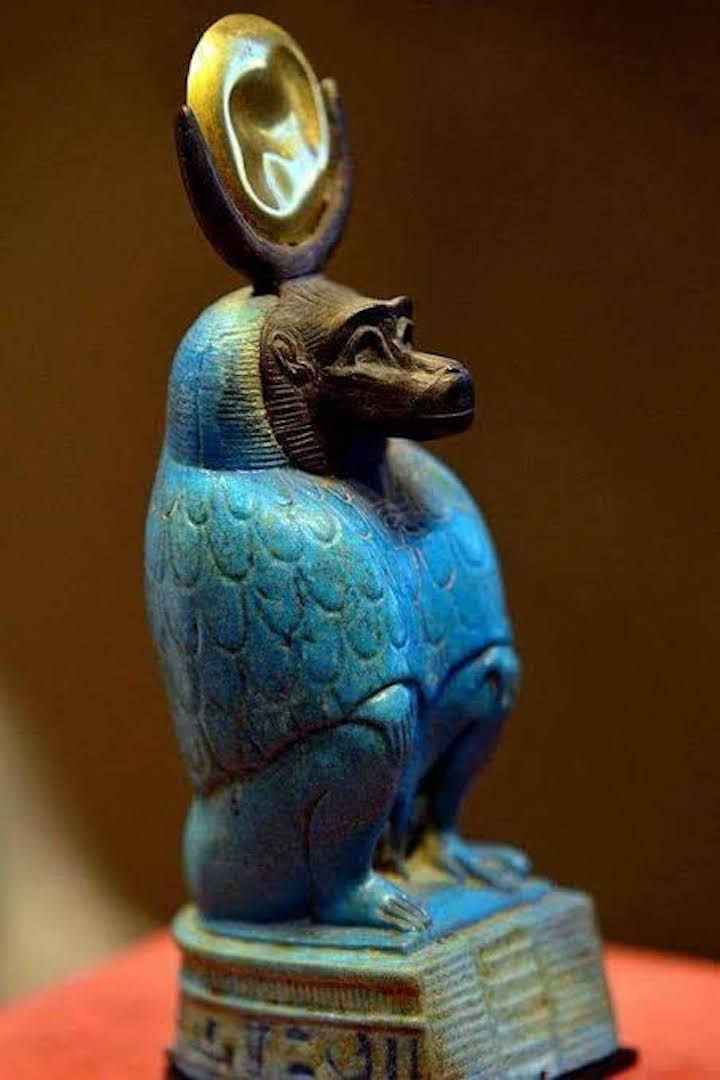
Their ritual was then approved and graced with the heka magic of Lord Jewhuti. For a brief moment, Asar's organ of regeneration rose back up, and the light-code of his soul passed into Aset as lightning passes from cloud to earth. In a single stroke of lightning, as bright as the star Sirius, Asar's soul DNA information had been transmitted into Aset's womb.
V. Heru's Childhood
Aset bore the child in a cave walled with papyrus and floored with lotus. Due to his conception, Heru was sickly from birth. Aset raised him into health by discipline and alchemy: healing rituals performed in sequence, timed to the movement of the stars, done every day without fail.
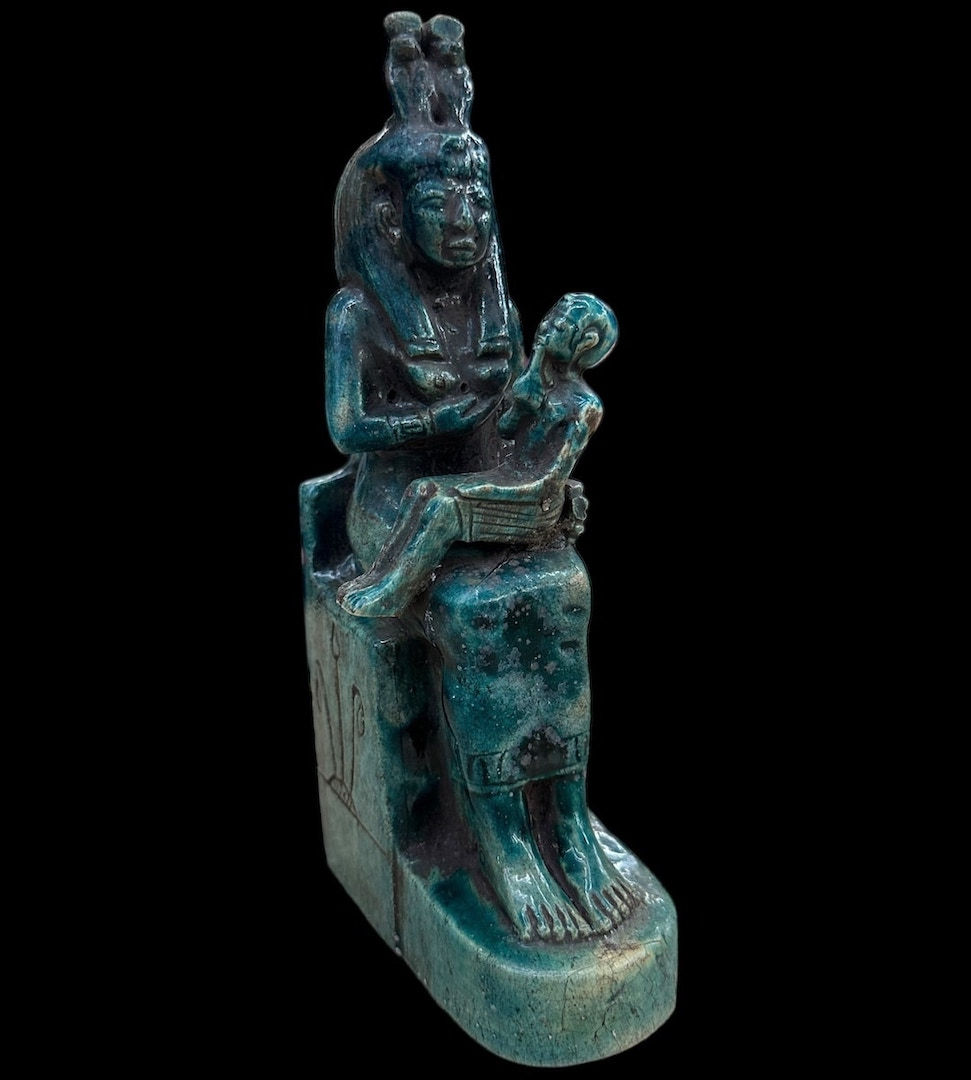
And as the divine mother built up her child, divine beasts of chaos repeatedly threatened the life of the curious boy. Heru was poisoned again and again, and more than a few times Aset held her lifeless child in her arms. Every time, it was either her alchemy or the grace of Lord Jewhuti's magic which brought the child back to life. On his thirteenth birthday, Aset and Jewhuti told Heru what had been done to his father.

VI. The Court of the Neteru
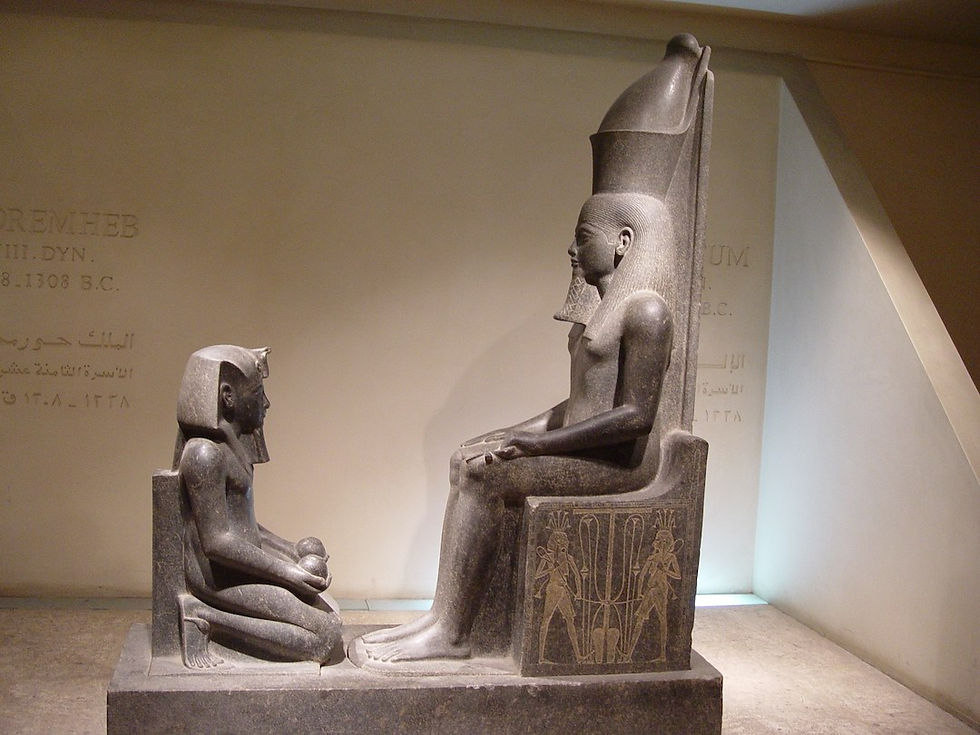
After Jewhuti taught Heru how to enter into his astral form, Heru went up to the Court of the Neteru in the sky, where Heru the Elder presides. Heru brought a civil claim for his inheritance, the throne of Kemet, yet he was careful not to charge the powerful warrior Set with fratricide.
Upon his arrival at the Court of the Neteru, Set called Heru an illegitimate bastard with no right even to file a civil claim, nor to stand amongst the Neteru. Nut and Geb, sitting as the principal jurors, ruled for Heru, as they knew that Aset would never have a child by any other than Asar.
VII. The Court of Righteousness
The verdict was sent up to the higher court, called the Court of Righteousness. This court is in Duat, the underworld, and is presided over by the First of the Neteru, Lord Atum.
Lord Atum did not overturn the verdict, yet he delayed upholding it, declaring that Heru must wait until he was strong enough to prove he was ready to be King.
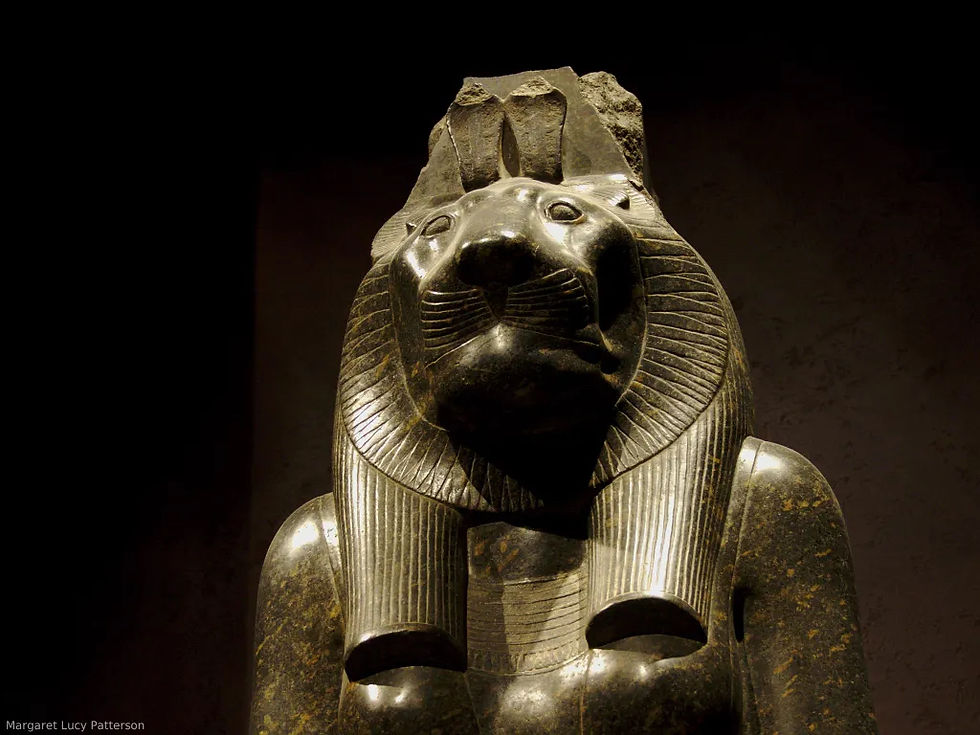
Aset sent Heru to Anpu and the other Neteru of war and power, and they began to train him in the martial arts of war. These were the commanders of Asar's army — such as Montu and Sekhmet — who had been waiting to train Heru ever since the day their King was ambushed in the Delta.
VIII. The Delta Duel
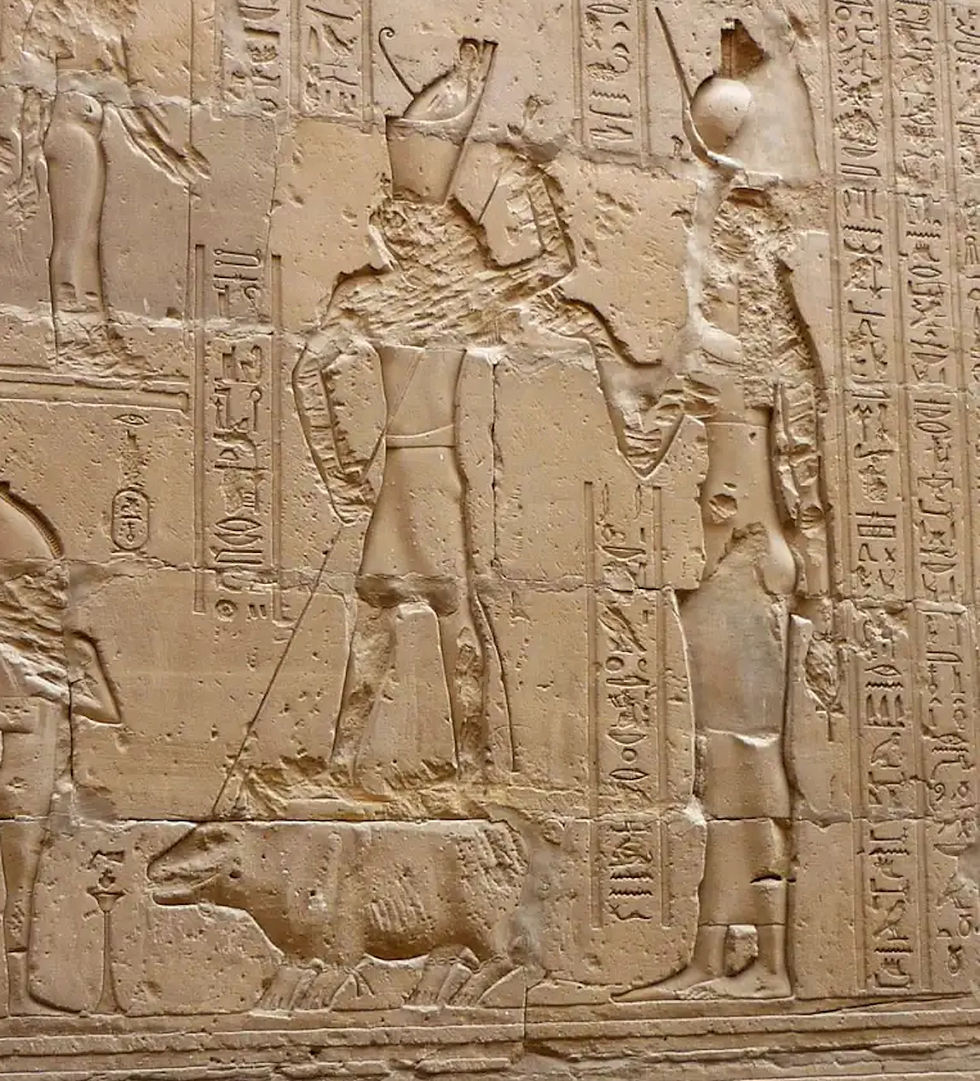
At fourteen, Heru finally challenged his uncle, and he agreed to fight underwater near the Delta in the form of hippopotami. Though this was all to Set's advantage, Jewhuti had taught Anpu how to build a massive magical net that could hold Set's hippopotamus form.
After they began to fight underwater, Anpu caught Set, and Heru emerged and began to land harpoon blows. But before the killing strike, Anpu let Set go, due to the hypnotic wailing and crying of Aset.
Set had begun to cry out to his sister, and Aset began to feel sympathy for her misguided brother. Her magical powers caused Anpu to release his grip on the net, and Set fled for his life.
IX. The Eye of Heru
In his divine falcon form, Heru chased after his uncle alone, in a furious rage. Set transformed from a bat to an aardvark to a snake to a scorpion, until Heru had lost sight of his uncle. After Heru came down to search for him, Set turned into the form of a sabertooth.
Set ambushed Heru and tore out his left eye. Anpu arrived and managed to brand the fleeing Set with a fire weapon. The marks seared into his hide became the archetype of the spotted pelt of every leopard and jaguar that has walked since.
And from that day, the leopard skin is worn at funerary rites across Kemet, on the shoulder of the one who performs the rituals.
X. Fourteen Days of Waning and Waxing
Heru was wounded and blind on one side, and healing him took fourteen days. Aset and Het-Heru, his wife, worked together to recreate more of his new eye each day. With diligence and wisdom and love, and the milk of a divine gazelle spirit, they were able to give Heru a complete new eye.
The light-body of Asar was ripped into fourteen pieces and scattered in fourteen places; and the light of the Moon, which is symbolically the Eye of Heru, is lost and then restored on the same count of fourteen.
XI. The Wedjat
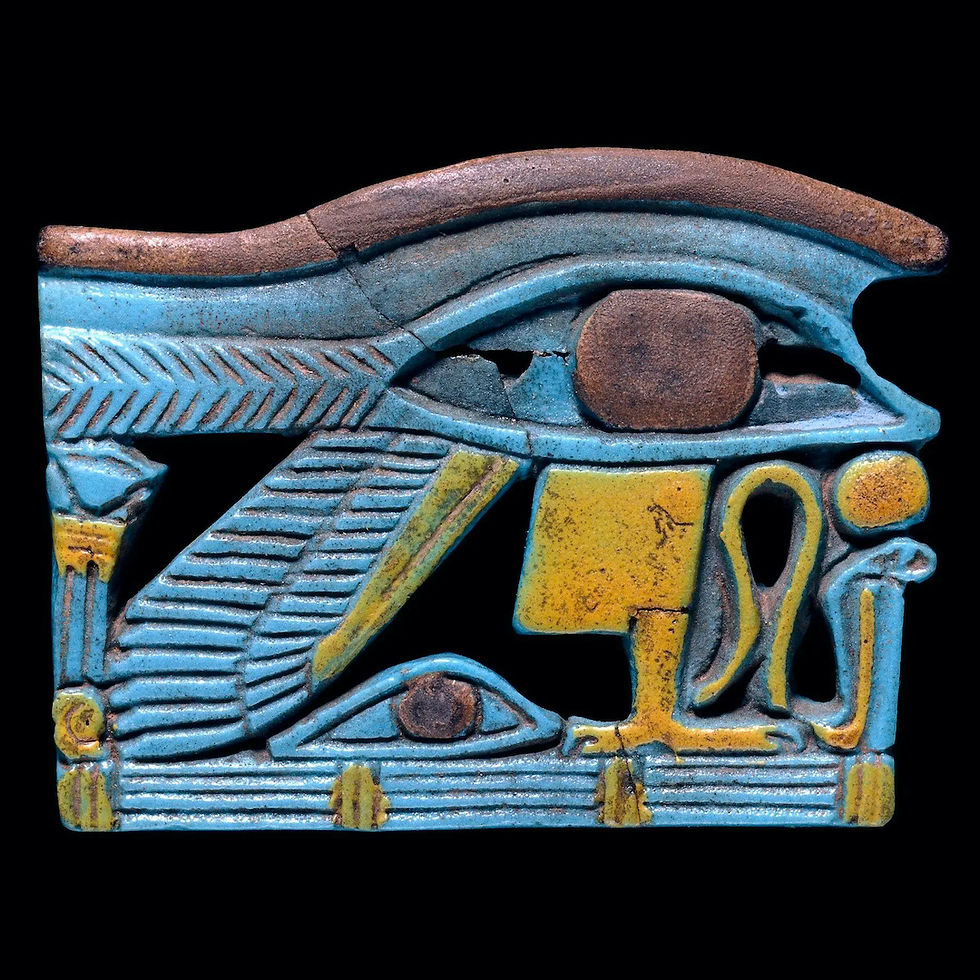
The gouged eye was recovered by a divine scarab beetle spirit, who gave it to Aset. Aset carried it to the top of a mountain, buried it, and watered the eye. After Jewhuti worked his magic over the ground, a massive mound grew from the burial, and from the top of the mound emerged a lotus flower.
When the lotus flower opened, out came the restored eye. Having gone through the fire of trial and tribulation, the eye had become exponentially more powerful than it had ever been before. It had become the Wedjat: the whole, sound, tested, enlightened, and perfected First Eye of Heru.
XII. The First Atonement and Resurrection
Jewhuti showed Heru how to use the Wedjat to see into, and then enter, the hyperspace of the Duat, and taught him the ritual he would need to perform. When Heru found the silent and weakened and ghostlike soul of his father, Heru opened Asar's mouth.
Heru then placed the Wedjat on his father's tongue. This first atonement is also the first and archetypal offering to a venerated ancestor, for the sake of comforting their soul in the afterlife.
The First Eye of Heru given to Asar is the prayer spoken for an ancestor, the food set out on altars, the name of the ancestor said aloud. The souls on the other side of mortality are fed by the service and love of the mortal, and what feeds them is being seen and heard and remembered and called out to.
With the anointing power of the Eye of Heru, Asar was redeemed and KRS — resurrected. And so Asar had become whole and sound and wedjat.
XIII. The Ancestor's Testimony
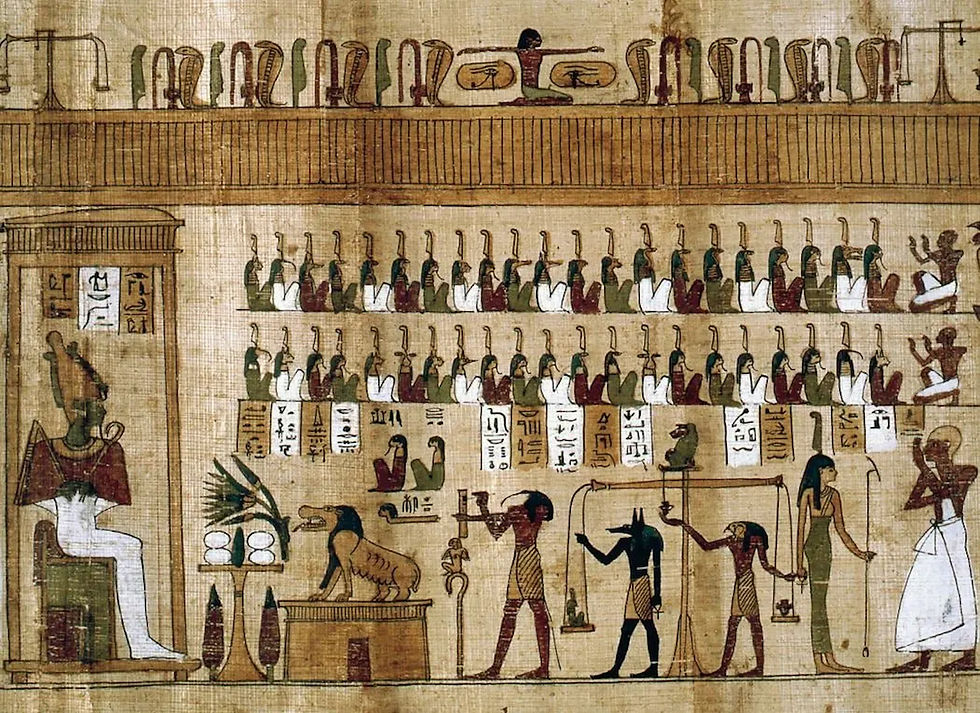
With his soul redeemed, Asar inherited all of his powers as the new ruling god of the underworld. He now had command over the chaotic primordial forces that are chained up in the Duat. And now he was free to enter the Court of Righteousness, for he was to become its new high judge.
Asar testified before Lord Atum. He accused Set of fratricide, and he promised Lord Atum that if there was no justice for this capital offense, he would loose the primordial forces that are held beneath Duat.
Asar promised to send these chaos beasts against the Neteru, the gods who command the forces of nature. This would lead the world into chaos, until there were no humans left to feed the gods with praise and worship and conscious attention.
XIV. The Winged Disk
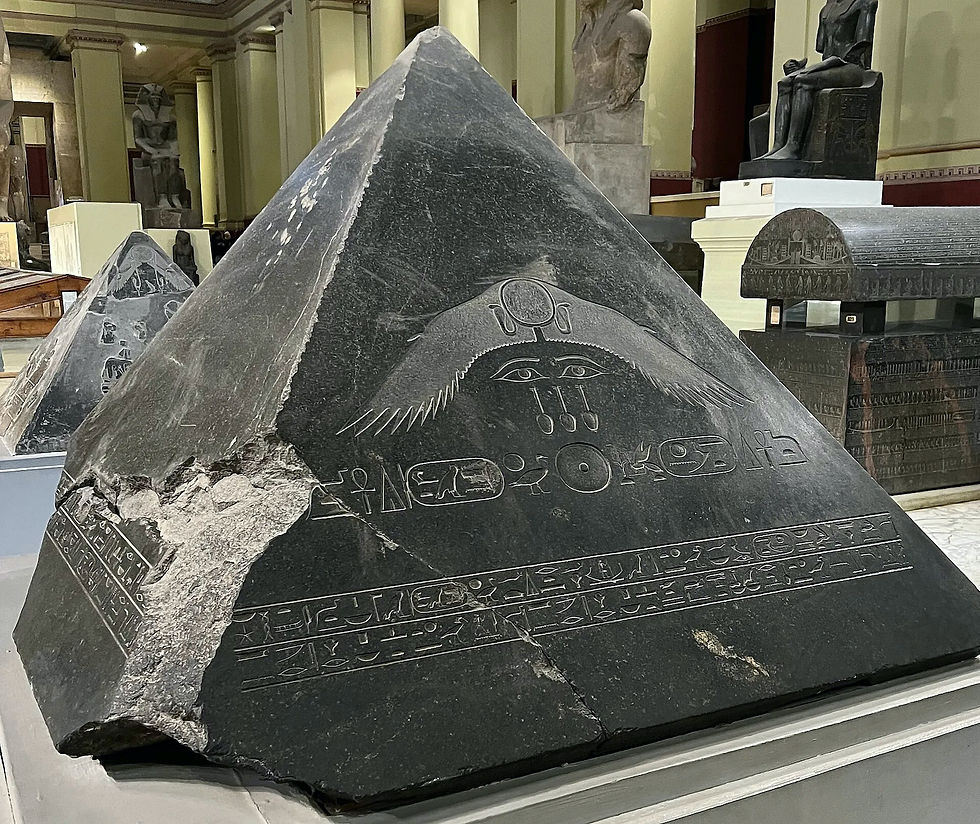
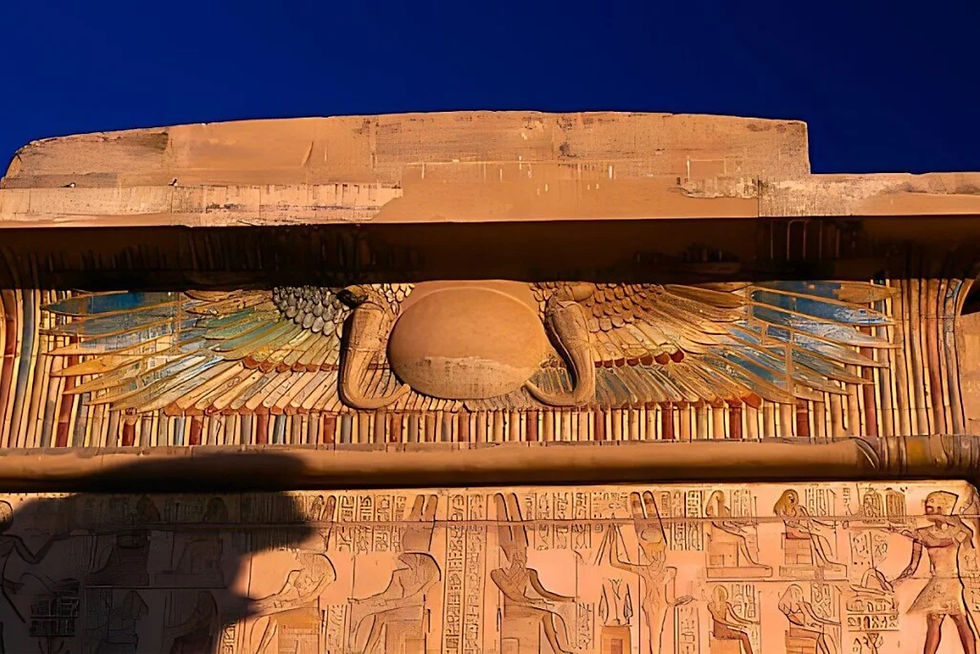
Lord Atum then gave Heru the cosmic power of destiny, which is the aura of the Winged Disk. Heru returned to the Court of the Neteru, and Heru the Elder declared him the rightful ruler of the world. Set conceded the throne willingly upon seeing the Winged Disk aura of Heru, and he convinced Maga and his commanders not to die challenging the now super-powered Heru.
Heru and Set reconciled their differences, before Set was sent to Ra the Sun to serve his sentence. Set is now stationed forever on the solar barque, working through every night at the prow, as the god of thunder. Set defends Ra from the last primordial chaos beast, which lurks free forever in the darkness beyond Kemet's heavenly horizons.
The 12 Stages of Spiritual Development
Lord Heru's journey gave Kemetians a living spiritual system they could use to bring the divine and the miraculous into everyday life, and its true power is that it mythologizes the real events of a human life — birth, sickness, law, and funerals. It is especially powerful for understanding one cycle of spiritual development: the process by which a person's spiritual understanding and identity either transforms, or significantly advances toward their highest possible connection with their world. This is what takes place when a person changes religions, or simply begins to invest more time and energy into their current spiritual system.
1. The Ordinary World as the Ordinary Worldview
Heru begins as a naive and vulnerable child, symbolizing the individual unknowingly about to begin this journey. He inherits a worldview that is already broken, because Set is already governing. Set represents the default spiritual worldview and the current level of thinking, which took power while the higher conscious thinking represented by Asar had its attention elsewhere. The hero does not yet experience his thinking as broken or insufficient. He experiences the spiritual culture he inherited as normal, and as central to his worldview.
2. The Call to Adventure as the Initiation of Information
Aset tells Heru on his thirteenth birthday what was done to his father. The call to adventure is an initiation of information, as it so often truly is: you learn a fact that challenges your materialist belief, or one that makes you question the morality of your religious leaders. It cannot be unseen, and you cannot deny it, deflect it, or distract yourself away from it.
Perhaps it came as a message in a dream, or through an instant of synchronicity that forever changes your view of what is spiritually possible. You have learned that allegiance to a naive worldview has cost you your inheritance as a sovereign soul — free to believe the truths that reach its own awareness, rather than enslaved to what it was told to accept.
3. The Refusal as Delay
Heru wins his civil case, yet the highest authority tells him he is not ready. The refusal comes not from the hero but from outside him, and in spiritual development this delay is usually a limitation of space or time, such as a lack of access to knowledge.
The hero begins searching for answers but does not know what books to read or what temples to visit, and is hindered by his own ignorance. He researches the wrong things, and his confidantes tell him to give up his strange questions and his fascination with foreign worldviews.
4. Meeting the Mentor
Just as Heru is guided to his mentors, the Neteru of war, so the evolving individual is miraculously led to an organization, a source of information, or a mentor who helps them find their new worldview. This mentor is always someone already close in proximity — just across the street, or in the next building over — yet the individual had never been looking for information in that place.
It could be a local temple or learning center you had never entered, though you had passed it dozens of times. And like the Neteru of war, this mentor will be eager to teach, because the sincerity of the hero's newfound interest inspires them to teach at their highest level.
5. Crossing the First Threshold
Prepared for a year by his mentors, Heru attempts to prove he is strong enough to be king, accepting Set's terms and fighting underwater — out of the light — as mighty hippopotami. Here the individual finally reevaluates their previous values, lets go of old beliefs, and expresses the new worldview outwardly.
They gather with others who reflect their new aspirations, and may begin wearing items that reflect them. Without this external step into the risky waters of the new way, the individual may fail to sacrifice the old worldview's principles, and revert back into allegiance with it.
6. The Road of Trials
Heru leads Set into the trap and Anpu catches him in the net, but Anpu lets Set go, due to a sister's misguided cry of concern. In a cycle of spiritual development, the biggest obstacle will always be those who know you as your old self — those who expect you to maintain forever their ordinary worldview and way of worshiping, which they will forever experience as the only legitimate spiritual system.
These are parents, siblings, friends, associates and spiritual leaders, whose genuine concern with your new views will always be the greatest trial on the road to personal enlightenment. Yet there will also be new friends and allies who appear along the path.
7. The Inmost Cave as the Chase into the Soul's Dark Night
Heru's chase of the ever-changing Set represents the individual's continued search for the contradictions between their old and new ways of thinking. They must hunt within themselves for the last vestiges of their intellectual and social allegiance to the old way, so that they may finally feel confident they have become a new person with a new spiritual worldview. And when they find those long-held beliefs, they are ready for the most traumatic stage of their cultivation.
8. The Ordeal
The central ordeal of Heru's journey is the loss of his left eye, similar to Odin sacrificing his eye for wisdom and to the Christ of Nazareth sacrificing his life for humanity. What is lost is the former way of seeing, which is the former way of thinking and being.
In spiritual development this is the loss of a belief that was once crucial to you. Perhaps you had always been sure the chief god was a man, and now, accepting the new way of thinking, you realize that God is feminine in nature. It is like losing something as fundamental as your sight, because it completely shifts how you see the spiritual world.
9. The Reward
Though Heru does not kill Set, he reconciles with the shadow self, proving he is strong enough to be king. Though his worldview was wounded by the ordeal, he is rewarded with new confidence and conviction and power, represented by the Wedjat.
The new eyes of Heru represent two things: the restoration of a complete and whole worldview after the ordeal, and the power of faith in the new way of thinking. These two gifts become the key to his heroics, for he does not keep them for himself, but uses them to continue his heroic journey.
10. The Road Back
Heru must return — not to the ordinary world he inherited, but to the Court of Righteousness in the underworld, the source of his delay and the reason he is not yet sovereign in his new way of being.
That court is the court of truth for the developing individual, where they must finally prove their new way of thinking, and often it is in the home of their parents, or in debate with their old spiritual community. Using the power of their conviction, the hero proves he can restore spiritual wholeness and vitality and honor to the spirit of his ancestors.
11. Resurrection
After the final ordeals on the road back, Heru proves his fitness to be king not by egotism and conquest but through humility and altruism. Instead of attacking Set, who is the dominant worldview, he completes the self-sacrificing mission that fate forced upon him, and honors his ancestors. He uses the Wedjat to resurrect Asar into his rightful place as god of the Duat, and only then is he truly sovereign of his new way.
By honoring and revering the ancestors of their new worldview, the individual proves their sincerity, and is reborn at their new level of spiritual understanding and identity.
12. Return with the Elixir
At the end of the story, Heru becomes not only the winged-disked rightful king but the savior who has shown the way to magic and healing and power for all those who walk his way.
Every son who eulogizes a father stands in Heru's place and wears the branded pelt of the leopard. Every offering set down is his Eye given again to Asar. Every child who needs healing is Heru, and every doctor and mother is Aset, with all the same rights to the miraculous powers of alchemy and heka and divine grace as the mythic family.
At the end of a cycle of spiritual development, the elixir is the new joy and serenity and identity the individual achieves, and these same feelings are the elixir they share with their old and new communities. They have found the spiritual worldview that is true for them, and they may now walk through life with the power of that truth, and the power to share their new appreciations with the world.
Summary
From the very first globally recognized superhero, Lord Heru of Kemet, and even until today, the hero's journey has always been used to reflect symbolically the periods of deep change which we all face from time to time.
We may also use it as a bridge to understanding the spiritual heroes of other cultures, for all of them — from Heru to Herucles to the Christ of Nazareth and Krishna — can be understood as symbolic examples of the process by which an ideal person starts as one version of themselves and is then made to become the version that is more authentic and more aligned with their true joy and purpose. Once we understand them this way, we may appreciate their examples from a nondenominational perspective: atheists and Christians can appreciate the sacrifices of Buddha, just as Buddhists and Hindus have come to appreciate the sacrifice of the Christ of Nazareth.
Their longevity proves that they already resonate with the human spirit. Hollywood and fantasy writers constantly use the hero's journey, yet these writers come from atheist and Western spiritual systems, and so they routinely fail to provide the spiritual depth available in the ancient stories. Not only do they fail to convey what we humans are capable of becoming at our best, but they routinely underestimate how evil humans can become without a strong moral system.
Producers and book agents routinely state that they are not looking for morally perfect heroes, yet a society that has no heroes who embody the best in us is at risk of being destroyed by the real living humans who embody the worst in us. No other animal on this planet can be as evil and self-centered and destructive to others as humans, and so it is vital to society that we idealize heroes who sacrifice themselves in the name of the greater good.
This was Lord Heru aka Horus: the god of the sky, the god of the divine right to rule, the god of divine protection earned through strategy and righteousness. Lord Heru was the backbone of the Kemetic spiritual system, and every ruler of Kemet was seen as his living embodiment — and like Heru, every ruler had to regularly prove that they were strong enough to lead the fight for Maat against the forces of chaos and lawlessness.
And as the rulers of our own lives, on our own hero's journeys, we too must align ourselves with what is best within us, deep within our unconscious and soul, and forever overcome the darkness that lurks beyond the shadows of what we think of ourselves.
If you enjoyed this blog or learned something new, please show your support however you prefer. Be sure to grab our spiritual fiction book NETER and some of our other inspirational and books at Katalize.net. You can sign up to the newsletter there, and send a donation at the link at the bottom.
Until next time, Ankh, Udja, Seneb! Health, wealth, and prosperity to you and yours! Godspeed my FRIENDS!
______________________________________________
Appendix: Sources
Almost every element above is drawn from a named source. The following are my own synthesis, offered as a modern Kemetic reading rather than as a claim about any single surviving text: the understanding of the scattering of the fourteen pieces as a deliberate attack on Asar's standing to testify; the conception described as the transmission of a 'light-code'; and the gathering of these fragments into one continuous narrative at all.
The reconstruction above is assembled from the following:
Primary Sources___________
Pyramid Texts (c. 2350–2150 BCE). Trans. R. O. Faulkner, The Ancient Egyptian Pyramid Texts (Oxford, 1969); James P. Allen, The Ancient Egyptian Pyramid Texts (Atlanta, 2005).
Coffin Texts (c. 2100–1800 BCE). Trans. R. O. Faulkner, The Ancient Egyptian Coffin Texts, 3 vols. (Warminster, 1973–78).
The Great Hymn to Osiris, stela of Amenmose (Louvre C 286), Eighteenth Dynasty. In Miriam Lichtheim, Ancient Egyptian Literature, vol. II (Berkeley, 1976).
The Contendings of Horus and Seth (Papyrus Chester Beatty I), Twentieth Dynasty, c. 1160 BCE. Ed. Alan H. Gardiner, The Library of A. Chester Beatty (London, 1931); trans. Lichtheim, AEL vol. II; William Kelly Simpson, The Literature of Ancient Egypt (Yale).
*The only long connected Kemetic narrative of the conflict. Carries the divine lawsuit and its courts; Set's charge that Heru is illegitimate; the duel fought underwater in the form of hippopotami; Aset's intervention and Set's release; the tearing out of the eye; Het-Heru healing the torn-out eye with the milk of a gazelle; the letter from Asar in the Duat that finally forces the verdict; and the crowning.
The Memphite Theology (the Shabaka Stone), inscribed c. 710 BCE. In Lichtheim, AEL vol. I.
The Metternich Stela, reign of Nectanebo II, c. 360–343 BCE. Metropolitan Museum of Art. Nora Scott, "The Metternich Stela," Metropolitan Museum of Art Bulletin 9, no. 8 (1951).
Per em Heru aka The Book of the Dead (from c. 1550 BCE). Trans. R. O. Faulkner and Ogden Goelet, The Egyptian Book of the Dead: The Book of Going Forth by Day.
Papyrus Jumilhac, Ptolemaic, c. 300 BCE. Ed. Jacques Vandier, Le Papyrus Jumilhac (Paris, 1961).
*Anpu as the commander of Heru's armed followers, his ferocity a match for Set's. The branding of Set and the origin of the spotted pelt, and the wearing of the leopard skin at funerary rites. The burial and watering of the eye, from which growing things emerge.
The Mythological Manual of the Delta (Papyrus Brooklyn 47.218.84). Ed. Dimitri Meeks, Mythes et légendes du Delta d'après le papyrus Brooklyn 47.218.84, MIFAO 125 (Cairo, 2006).
The Myth of Horus at Edfu, Temple of Edfu, 237–57 BCE. H. W. Fairman, "The Myth of Horus at Edfu: I," Journal of Egyptian Archaeology 21 (1935); A. M. Blackman and H. W. Fairman, "The Myth of Horus at Edfu: II. The Triumph of Horus over His Enemies: A Sacred Drama," JEA 28 (1942), 29 (1943), 30 (1944); H. W. Fairman, The Triumph of Horus: An Ancient Egyptian Sacred Drama (London, 1974).
Papyrus Geneva and the Horus cippi.
Plutarch, De Iside et Osiride, c. 100 CE. Ed. J. Gwyn Griffiths (Cardiff, 1970); Loeb Moralia vol. V.
*Listed to mark what has been deliberately excluded: the perfectly measured coffin, the body part eaten by the fish, and Heru's fury against his own mother.
Studies
R. A. Schwaller de Lubicz
The Temple of Man, 2 vols., trans. Deborah and Robert Lawlor (Rochester, 1998; French ed. 1957). Sacred Science: The King of Pharaonic Theocracy. Symbol and the Symbolic: Egypt, Science, and the Evolution of Consciousness. Esoterism and Symbol, and The Temple in Man.
John Anthony West, Serpent in the Sky: The High Wisdom of Ancient Egypt (1978) — the standard study of Schwaller's work.
Comments